
Renovating a damp house: the renovation firm’s schedule
September 28, 2026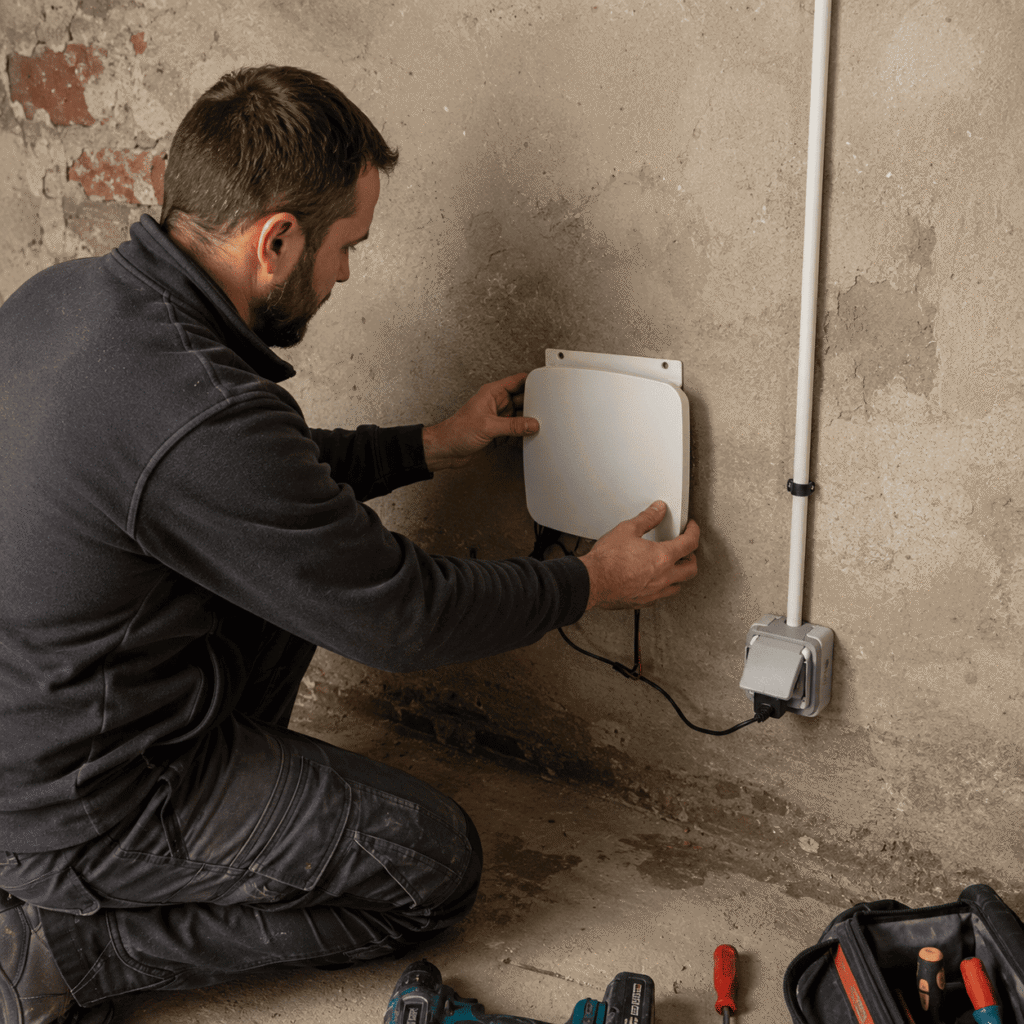
Deciding to diversify your business as a building tradesperson doesn’t mean changing trade. It means adding a service close to what you already do, that your clients are already asking for, and that doesn’t force you to invest heavily or spend months retraining. Rising damp treatment, indeed, ticks every one of those boxes: it grafts onto your existing site visits, takes minutes to fit, and leads to work you already know how to do.
Why diversify your business as a tradesperson
The reasons vary from one firm to the next, but they usually come down to the same observations:
- an order book that depends on a single type of job, or a single client;
- quiet periods that come and go with the seasons;
- site visits that go nowhere, because the client wanted something else;
- the same requests, over and over, that you turn down with «that’s not my trade».
That last point says the most. Every request you turn down reveals a need your clients are already voicing, one that another professional will pick up in your place.
A poorly chosen diversification has the opposite effect: time wasted learning, kit gathering dust in the van, clients let down by a service you hadn’t really mastered. That’s, in fact, the case for weighing up every idea before committing to it.
The four tests before you diversify your business
It extends your trade
Same clients, same jobs, same site visits. A service that forces you to go looking for clients elsewhere, indeed, costs far more to get off the ground.
It needs little investment
No expensive tools, no extra vehicle, no stock to fund. You should, in short, be able to test it on a job without tying up your cash flow.
It answers a demand that’s already visible
The best opportunities are the ones your clients bring up themselves during site visits, without you having to create the need.
It stays under your control
No franchise, no royalties, no exclusivity tying you down. You move at your own pace, and change course if the trial doesn’t pay off.
Diversify your business with rising damp treatment
Besides, run through this grid, and fitting polarity inverters ticks all four boxes.
- Close to your trade: painters, plasterers, bricklayers, tilers and renovation firms regularly come across damp wall bases. Diagnosis and fitting are a natural extension of what you already do.
- Little investment: the ATE runs off an earthed socket that’s already there, permanently live; no drilling, no chasing, just a few minutes to fit. With no minimum order, a single device is enough for a first job.
- Visible demand: in older stone or brick buildings, occupants, for example, see the salt staining and the blistering paint, and ask the tradesperson already on site about it.
- Under your control: no franchise agreement, no minimum commitment, no territorial exclusivity to respect. You order when a job calls for it.
Overall, the service goes beyond fitting the device. Stripping out sealed render and paint at the base of walls, removing stud partitions, sorting out gutters and downpipes, and applying breathable finishes once the wall has dried out: all work you can invoice for. A full example on the renovation side: renovating a damp house, the firm’s schedule.
Testing how you diversify your business in six steps
Step 1: spot the need in your own jobs
Go back through your quotes and site visits from the last few months. Which clients mentioned a damp wall base, salt staining, a skirting board swelling up? They’re still your first prospects.
Step 2: master the diagnosis and the fitting
The treatment targets a single phenomenon: rising damp. Rainwater getting in, flood damage, surface mould: all outside its scope. Telling the difference is the key skill. As for fitting, the rules are short: load-bearing wall, device low down and in contact with the masonry, never in a corner, and the model chosen on the distance to be covered. The site guide and each device’s notice cover the rest. For a deeper technical comparison, see how to choose a damp proofing device.
Step 3: set up your trade account
On Help Humidité Pro, the sign-up form asks for your company details: business name, registration number and contact details. Besides, within two minutes, the account is approved and trade pricing becomes visible.
Step 4: carry out a first job
Pick a client who trusts you and a clear-cut case of rising damp. In a single-family house, the most common model is the ATE LC30, or its ATE Pulse version, covering 30 metres. For a smaller area, the ATE LC15 covers 15 metres; for a large volume, the ATE MAX goes up to 60 metres. No permanently live earthed socket available? Choose the ATG instead, which runs without electricity. Allow 7 working days for delivery, which is free.
Step 5: make the service visible
Add it to your quotes, your marketing materials and your website. Help Humidité Pro, moreover, provides ready-made copy you can use on your site, plus illustrations and sheets to back up your quotes. For your pitch, see our advice on presenting the solution to your clients.
Step 6: review how you diversify your business
After a few jobs, do the maths: time spent on diagnosis and fitting, associated work sold, clients who’ve recommended you. If the service fits into your schedule without disrupting it, it’s earned its place in your line-up. If not, you haven’t tied up any stock or commitment.
The mistakes that sink your plan to diversify your business
- Promising a quick result: a wall generally takes 18 to 24 months to show improvement. Say so before you sign anything.
- Treating without diagnosing: a leak or condensation falls outside the device’s scope.
- Fitting it in the wrong spot: in a corner, on a stud partition, or behind a stud wall, and the result is compromised.
- Forgetting the associated work: a wall base still covered in cement render dries badly, device or no device.
- Spreading yourself too thin: the new service should serve your main trade. Start with your own clients before looking further afield.
- Overlooking insurance: check with your insurer that the new service falls within your declared activities.
Diagnosing, fitting, advising the client: that all stays your business, and that’s where your added value lies. Help Humidité Pro, in fact, sticks to the equipment and the documentation: devices made in Castres, a 10-year manufacturer’s guarantee, technical sheets and fitting notices.
Frequently asked questions
Which professionals can order the devices?
You need a registered company whose trade relates to the home, or a specialist distributor. That covers painters, plasterers, bricklayers, tilers and renovation firms.
Do you need to buy stock to get started?
No. Single-unit ordering is available: you buy job by job, with volume discounts when you take several devices.
How quickly can you diversify your business?
The account is set up in two minutes and the device arrives within 7 working days. The real time investment is learning the diagnosis.
How do you present the device to the client?
Lean on the explanatory sheets provided and set expectations: a timeframe measured in months (18 to 24, generally) and a scope limited to rising damp. Another solid argument: the ATE draws about 0.75 W, roughly €15 of electricity a year.
In summary: how to diversify your business
Diversifying your business as a tradesperson works when the new service extends your trade, costs little to test, answers a demand that already exists, and leaves you free. Rising damp treatment ticks every box: spot the need in your own jobs, open your account on the Help Humidité Pro shop, carry out a well-diagnosed first job, then make it known.


